
SIRVA CFB Borden Relocation Rules for Angus Buyers
Two families can receive posting messages to CFB Borden in the same week, both bound for the same stretch of Essa Township, and still end up on completely different relocation systems. Not because of rank, not because of which unit they're joining, and not because of anything either family did wrong. The split comes down to a single date stamped on their file: when it was authorized.
As of January 6, 2026, SIRVA became the federal government's Contracted Relocation Service Provider for the Canadian Armed Forces, replacing Brookfield Global Relocation Services, known to almost everyone in the posting world simply as BGRS. Files authorized on or after that date run through SIRVA. Files authorized before it stay on BGRS until they close. Neither your posting date nor your Change of Strength date determines which system you're in. Authorization date does. That distinction sounds small until you're the family calling the wrong provider three days into a five-day house hunting trip.
The government's own relocation directive page states the rule plainly: SIRVA handles relocation files authorized on or after January 6, 2026, while BGRS continues administering files authorized before that date. CFMWS Borden's housing and moving page confirms the same split and adds a practical wrinkle: members transitioning to the new system need to create a login through the SIRVA Forces portal and download the SIRVA Forces app, a step that didn't exist under the old BGRS workflow.
For a family whose posting message arrived in late 2025 but whose file wasn't formally authorized until the new year, this isn't academic. It's the difference between logging into a familiar BGRS account they've had bookmarked for months and discovering, days before a house hunting trip to Angus, that they actually need a SIRVA account they've never opened. The fastest way to find out which system applies is to check the authorization date on your posting paperwork or ask your orderly room directly. Guessing based on when a friend or colleague went through the process is how families lose HHT days to account setup instead of showings.
The entitlements themselves haven't moved. The Canadian Armed Forces Relocation Directive still governs what's covered, and both providers operate under the same framework.
| Under BGRS (files authorized before Jan 6, 2026) | Under SIRVA (files authorized Jan 6, 2026 or later) | |
|---|---|---|
| Portal | Legacy BGRS site | SIRVA Forces portal and app |
| Entry step | Standard registration | Preliminary Relocation Assessment (PRA) required before file activates |
| HHT structure | Same CAFRD chapter 4 rules | Same CAFRD chapter 4 rules |
| Core entitlements | Real estate commission, legal fees, home inspection, moving costs | Same coverage, same ceiling rates |
| TPSP directory | BGRS-listed providers | SIRVA-listed providers, access requires completed PRA |
The house hunting trip itself hasn't shrunk or grown. The government's own planning guidance describes a typical HHT as seven days and six nights including travel, which breaks down to five days at destination plus two travel days. That structure predates the provider switch and survived it intact.
What's genuinely new is the sequencing. Under SIRVA, a member has to complete a Preliminary Relocation Assessment before the file activates and before the list of approved Third Party Service Providers even becomes visible. That means a family can't casually browse for a realtor the way they might have under the old system. The PRA has to happen first.
Here's the friction point that catches families off guard during an already compressed timeline: being a registered provider under BGRS doesn't automatically carry over into SIRVA's directory. Realtors who spent years building BGRS credentials are now navigating a parallel registration process, and the practical effect lands on the family, not just the agent.
If your agent is listed in the SIRVA directory, eligible fees can often be paid directly by SIRVA on your behalf. If you choose someone outside that directory, you may need to pay upfront and file for reimbursement afterward, up to the CAFRD ceiling rate, which adds a cash flow step most posting families would rather avoid in the middle of a move. It's a detail worth confirming before your HHT, not during it.
One rule that hasn't changed and is easy to overlook: every Third Party Service Provider, real estate agent included, has to be at arm's length from the member. A spouse, sibling, or in-law can't serve as your realtor of record for a CAFRD-funded move, regardless of which provider administers the file.
Heather Beauchesne is an approved Realtor for CFB Borden military relocations and has worked through both the BGRS and SIRVA registration processes with families moving to and from Angus, Barrie, and the surrounding Essa Township communities.
Separate from the provider switch, a genuine benefit change took effect April 1, 2026. The CAF Mobility Allowance replaced the former Posting Allowance and applies to files with a Change of Strength date on or after that day, wherever in Canada the posting lands, including CFB Borden. It pays $13,500 for a member's first through third postings, $20,250 for the fourth through sixth, and $27,000 for any posting beyond the sixth. Members on Imposed Restriction receive half the applicable rate.
This allowance is a direct cash benefit separate from your IRP real estate cost coverage, which means it can be positioned toward a down payment rather than absorbed into moving logistics. For a family house hunting in Angus, that distinction matters. As of September 1, 2026, Angus had 82 active listings with a median list price of $799,000 and an average of 43 days on market. A member in the mid-tier Mobility Allowance range with a $20,250 benefit isn't closing the affordability gap on their own, but stacked with IRP entitlements and a pre-approved mortgage, it changes what's realistic to target during a five-day trip rather than what looks realistic on paper before one.
Angus sits closest to the base among the surrounding civilian communities, and its housing stock reflects that proximity: overwhelmingly detached homes, with almost no condo inventory to fall back on if a family's timeline gets tight. Knowing your numbers, your portal, and your provider status before you land for showings is what turns a five-day window into an accepted offer instead of a scramble.
Do I need accounts on both BGRS and SIRVA? Only if you have an open file on one system and a new file authorized on the other. Most members will only ever need the portal that matches their authorization date.
Does the provider switch change my HHT length? No. The seven days and six nights structure, including travel, comes from CAFRD chapter 4 and applies regardless of which provider administers your file.
Is the Mobility Allowance the same as my real estate commission reimbursement? No. The Mobility Allowance is a separate cash benefit tied to your Change of Strength date, while commission and legal fee reimbursement fall under your core IRP entitlements through whichever provider holds your file.
If your posting message to or from CFB Borden has you sorting through which portal applies, what your Mobility Allowance tier means for your budget, or which Angus streets are worth touring in a five-day window, Hearth & Home Team has walked other CAF families through the same paperwork. Book a consultation before you finalize your HHT dates.


CFB Borden
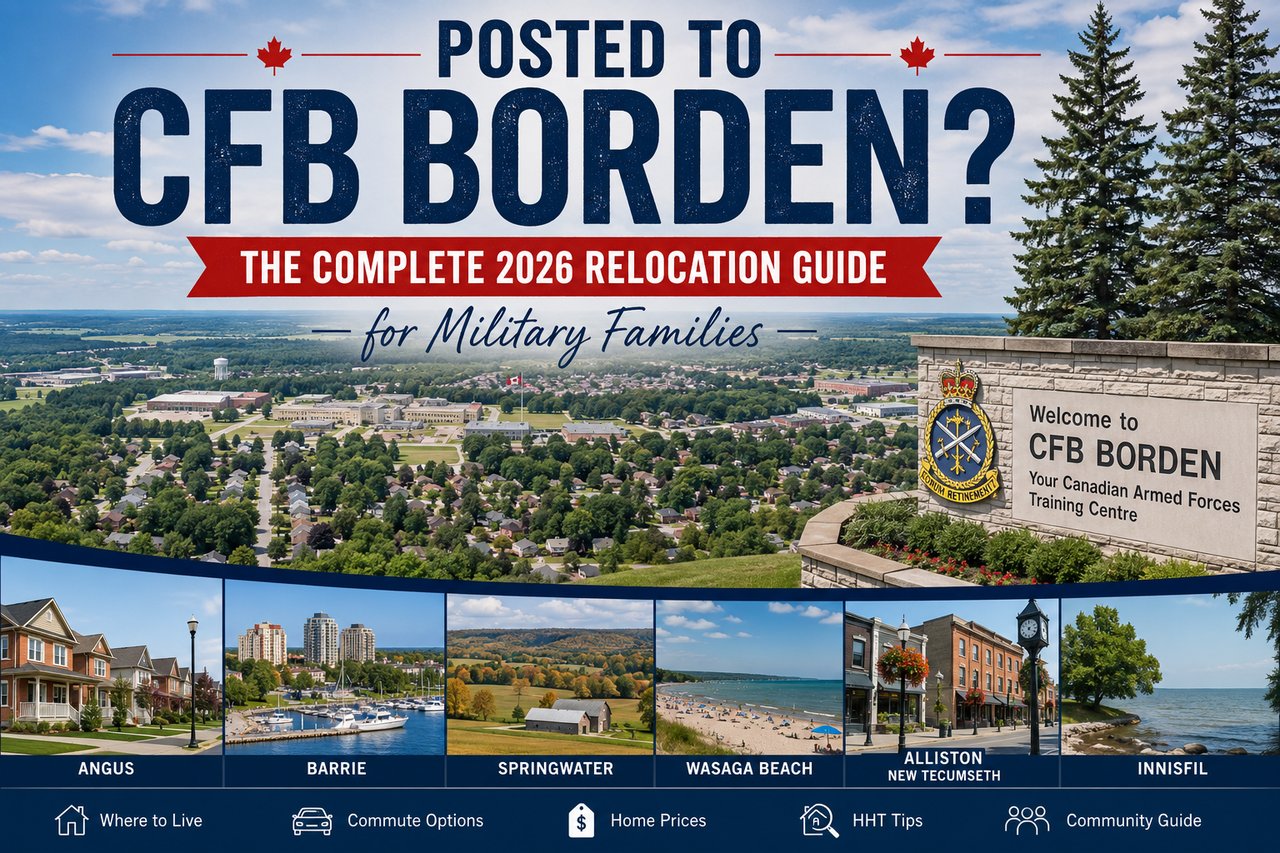
A Military Family’s Guide to Living, Buying & Relocating Near CFB Borden

Working with Heather Beauchesne means having a trusted Barrie real estate expert who brings over a decade of experience and a clear, people-first approach to every move. Specializing in residential real estate, first-time buyers, and military relocations near CFB Borden, she offers honest guidance, strategic insight, and steady support from start to finish.

Heather Beauchesne | Hearth & Home Team
218 Bayfield St Barrie ON L4M 3B6, Canada